Search This Blog

Wednesday, 26 August 2015

CF – BHS & I

In the summer of 1968, when I was visiting my parents at Meadow Lake, Saskatchewan, where they had moved to from Winnipeg year earlier, we took an evening drive out to the lake. There were some seaplanes at the dock there, including a Norseman and a Cessna 180. My father looked at the Norseman and said to me, "That is the one you rode on when you were a baby."


I am not sure if I had heard the story before, but I have certainly heard it since, most notably from my mother's father, Grandpa Frank F Enns. He felt he had to tell me it when I was doing a video-taped interview of him near the end of his life.

My parents were working as a missionary couple, a young minister and his wife if you will, for the United Church of Canada in Oxford House, Manitoba, where they were stationed from 1945-1947. In the late summer of 1946, my mother made her way to her parents' place on the farm where she had grown up in the Burwalde District north of the town of Winkler, Manitoba. After I was born and deemed old enough to travel, my grandfather took my mother and myself by train to what was then the end of the railroad at The Pas. This was where Tom Lamb would fly us out of to join my father in Oxford house.

I can re-check the details but it seems to me there were 2 problems. This was early December. It was what we in the north called "freeze-up." It was the time of year between when you could land on the lake with pontoons and when you could safely land on it with skis. So, in part we were stuck in The Pas waiting for the ice to be strong enough to land on. However, I think we may have been delayed to that point because of mechanical problems with the plane. The plane was the Nordouyn Norseman CF-DHS.

In any case, it wasn't until December that we took off from The Pas. For some reason it was late in the day, which is short there at that time of the year in any case, and we needed to make a landing in Norway House. Perhaps we had goods to unload or people that were destined for that location as well. In any case, it was really getting rather dark as we circled to land. The pilot thought he saw the strip on the ice which we were to land on, as there were evergreen branches on both sides of it. This was a common way of marking landing strips on snow-covered lakes in the north. However, again, in the deepening blue of the snow in the rapidly fading light, he could see figures running back and forth across the strip brandishing what appeared to be burning torches. There was nothing to it but to land somewhere else nearby.

Then the pilot and his passengers learned the awful truth. Those evergreens were to mark out where the locals had just made their first cutting of ice for fish preservation. If we had landed there, we would have gone straight through into the freezing waters.

I suspect this story meant so much to my grandfather because, not only was it an account of how his daughter and grandson were saved a possible death. It possibly also indicated to him, man of faith that he was. that we were destined for more.

In any case, it was not until my late 60s when I was thinking about my past and looking into aircraft that have been part of it, that I discovered more of the history of this aircraft.

Here’s a snapshot of its history:

New from the factory, the aircraft was registered as CF-BHS to Tom Lamb of Lamb Airways of The Pas, Manitoba, Canada, on October 4, 1945. Twenty-one years later, on May 16, 1966, the aircraft was sold to G.M. Clark and John F. Midgett of Meadow Lake, Saskatchewan, It was reregistered to C and M Airways of La Loche, in 1971, while on September 28, 1989 it was registered to La Loche Airways.

While taxiing on Cree Lake on October 11, 1989, fire broke out and the aircraft was beached on Prowse Island and subsequently damaged beyond repair by the fire. The registration was cancelled on April 4, 1990. Eighteen years later its remains had been rebuilt to static display in the colours of Lamb Airways and on June 28, 2008 unveiled on a pedestal in the Lions Park, Thompson, Manitoba, to commemorate the bush plane and their bush pilots, especially Tom Lamb.
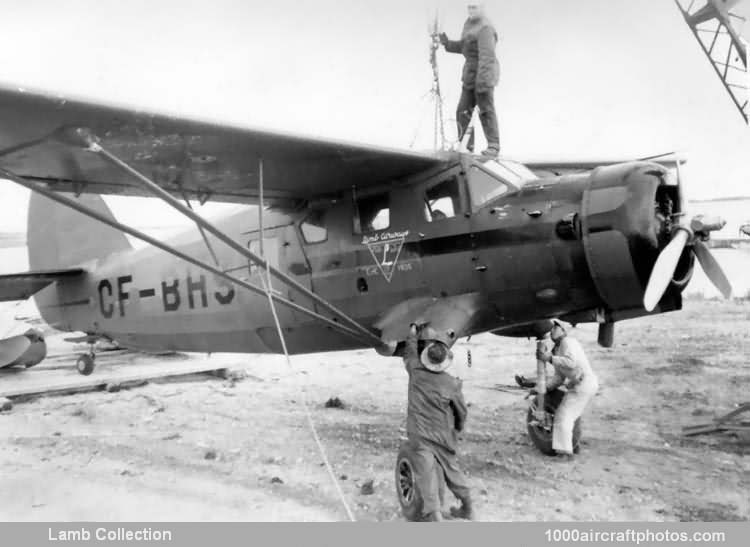

And here's Tom Lamb receiving it from the factory a short while earlier:
Loading Image
Lambair has their own website at:

 
At the top of their website is a picture of Tom and his sons Greg, Jack, Don, Dennis, Conrad (youngest), etc. Some of these names I remember well from my childhood in Grand Rapids, Manitoba [1948-1957]. By that time, Tom’s sons were already flying with him. The early Norsemen and Beavers were being augmented by smaller, faster, more modern Cessna 170 and 180s.


Their history is summarized on their website:

Lambair, which was incorporated in 1935 as Lamb Airways Limited, began with one aircraft - a Stinson SR8 five passenger plane. This plane was used to haul fish from The Pas, Manitoba to the rail head at Cormorant before the fish froze and before the market fell in Chicago. Tom Lamb, who established the airline, bought the Stinson in 1930 and taught himself to fly it.

Lambair grew from public demand, as there was no other means of transportation for fish to market at the time except horse-drawn sleighs. Airplanes shortened the time to market and ensured higher quality fish to the large North American market. While transportation of fish, fur, trappers and fisherman were its primary business, the largest expansion of Lambair was during the construction of the mid-Canada line during the 1950's. The airline served all of Canada and parts of the United States and Greenland during its years in service. Lambair continued to haul fish, but its primary cargo was people - Inuit families from Resolute, Northwest territories to the far Arctic island hunting camps; equipment - oil drilling rigs to Sable Island from Halifax and food supplies. Medical evacuations and emergency mercy flights also accounted for a substantial amount of the company's traffic from the far north.

I still remember one of those "mercy flights." Again, it was "freeze-up." Some of the men of the community, my father included, had gone out to begin to cut their wood supply for the winter before the snow got too deep and made it more difficult to call their loads back to the community. Suddenly, one of the young man, Norman McKay, severely gashed his foot. It was thought he needed to be taken to the nearest hospital, which was The Pas. A huge crew of men where quickly gathered together to hack down enough trees and pile enough snow together on the strip of land so cleared for a plane with skis to land on it. Lamb air was contacted by one of the local trader's radios and I think it was one of their new Cessnas that came in and took Norman out to get his foot fixed up. That was the beginning of the Grand Rapids air strip.

As development in the north progressed, Lambair opened new bases and served Wabowden, Thompson, Churchill, Norway House and Gillam as well as The Pas. These bases were established to serve all of northern Manitoba and the North West Territories. It carried out its own maintenance operations in its hangers at Churchill, Thompson and The Pas and in 1965 built a new headquarters at The Pas.

At the time, Lambair was Canada's oldest airline still under the original management. Upon the death of Tom Lamb in 1969, the founder's six sons, all pilot-engineers, ran the airline. By 1979, Lambair had a fleet which included Bristol freighters, twin otters, Otters, Beavers, Cessna 180s, Bell G4A helicopters, Twin Islanders, Aztecs and DC-3s. The planes were purchased from all over the world including Norway, England and Afghanistan. This fleet offered the greatest variety of aircraft to look after the traffic of the north, according to Donald Lamb, President of Lambair, in 1973. The combination of heavy freight aircraft with short takeoff and landing aircraft, to the fast light instrument flight rules (IFR) twin engine planes allowed the company to take on assignments for governments, oil companies, mining operations and continue to haul passengers throughout the north. The helicopters were for prospecting, hydro-electric development and forestry operations.

BOOKS: 
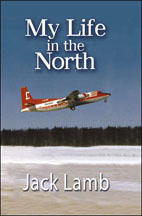
Lambair's history is detailed in the autobiography of Jack Lamb, "My Life in the North".


The youngest of the six flying Lamb brothers, Conrad Lamb has written his memoirs of living and working in northern Canada. "From Tractor Train to Bush Plane" is a series of stories about Conrad and his adventures while aiding in the development of the north.

In 1984, Pulitzer Prize winning author Leland Stowe published a biography of Tom Lamb called The Last Great Frontiersman. The book was based on a series of taped interviews (available on this website) with Tom Lamb prior to his death and with family members after. The book is out of print.
 Hilda Lamb Herbert was the middle daughter and middle child of THP and Caroline Lamb. The sister of Tom and Gladys (Billie), Hilda writes about her life growing up in remote northern Manitoba  In The Lambs of Moose Lake.

Gladys Lillian Lamb Allan also known as Billie documented her family’s early life at Moose Lake Manitoba in the book “Dew Upon the Grass”. This book is out of print.

And the BHS Norseman is featured here:

Loading Image
The slogan Tom and his pilot sons went by was: "Do not ask us where we fly . . . Tell us where you want to go"

Here is also my father's photo of the Norseman he remembered unloading supplies at Oxford House, MB in 1946. And look at the license letters on the side: BHS!


Here is probably how it looked when my mother and I rode on it in December 1946 [photo from Lambair website]:


Photographed ca. 1954, from Jack Lamb via Bill Ewing, it looks like it is being overhauled:


 Here is, I believe, Tom himself with it in Grand Rapids, or a different one - Lambair had 6 of them: MK4 CF-FUU Leased, MK5 CF-MAM snN29 26, MK5 CF-BHS snN29-7 1945, MK6 CF-GUQ, MK6 CF-INN and MK6 CF-ILR [photo from my father]


Here it is on some remote northern lake with a Husky and a Bell helicopter [photo from Lambair website]:


And finally, here's my photo of BHS 22 yrs later as I finally saw it again in Meadow Lake SK, in 1968.


And, finally, it’s last resting place [photos from the Thompson tourism website]:


Here’s another version of the story behind that:

A dedicated group of volunteers worked evenings and weekends for over two years to restore this crashed Norseman float plane that lay in the swamp near Garden Hill, Manitoba since 1969.  The rusty shell was rescued and brought to life in Thompson under the supervision of Fred Palmer and Marion Morberg. The plane, now fully restored sits atop a 14-ft tall pedestal in the Thompson Lions Club Park and is part of Thompson's Spirit Way walkway.   
Norseman float planes were the only such planes built in Canada.  These workhorses were critical in the development and evolution of Northern Canada.  Their unique three bladed prop and fabric skin made them legendary.  Only a few still fly today. 
Dedicated pilots in the North risked their lives to move supplies and people across the wide expanse of Northern Manitoba tundra and boreal forest.  
This stunning site pays tribute to the pilots, mechanics and support staff in northern aviation. 
Location:
Mystery Lake Road, right before the Miles Hart Bridge.

Website:


Lorne Brandt, acknowledging these photos, except for the ones my father took in Oxford House and Grand Rapids and the one I took in Meadow Lake are all 'borrowed' and can be found on the internet as cited.
2015 8 26


Monday, 20 July 2015

Childhood trauma revisited

Childhood trauma revisited

Preamble:
In mid-June 2015 I flew to Edmonton to visit my sister and ailing brother-in-law in Tofield, Alberta. My youngest brother, his wife and son were also there, and in fact picked me up from the airport.

This nephew has been living in Montréal for some time, although he grew up in Winnipeg. He rather surprised us when he came upstairs to the dining table one evening with several photocopied pages from a book that he had questions about.

Turns out my nephew had seen a sign about Mennonites and residential schools at some kind of a demonstration in Montréal. He knew enough about our people's history to question that and so went to the nearest municipal library to do some research. There he found T. D. Regehr's Mennonites in Canada 1939-1970, A People Transformed. The pages he had photocopied where from the section on Missions to Natives, notably, pages 336 and following. He knew that some of these pages referred to his grandfather and wanted to know more from us about that.

The backstory:
The grandfather my nephew was referring to is my father, Edwin Brandt, who began his career working among the Indians in Canada (as everyone called them at that time) as described in the first pages of this section of the book. The author recounts first how the United Church of Canada was able to get Mennonites to serve in their teaching and church work as Conscientious Objectors during World War II. My father has told me about how he went to appear before a judge with a proposal to do this, but I had not realized this background.

So it was that he taught for 2 years at what was then called Island Lake, Manitoba. Later this community would be divided into Garden Hill, St. Therese Point and Wasagamack. Then, when the war was over he became a minister for the United Church in the nearby community of Oxford House. Before he really began this, he was married to Margaret Enns from the rural community of Burwalde north of Winkler, Manitoba, in the Morden Bergthaler Mennonite Church, her home church, even though he was Mennonite Brethren background himself. Thus it was that they began this period of service as a married couple, and I joined them in December 1946 as their first child. I was actually born in October, but my mother and I did not come back north until December, which is another story in itself. During this time, my father really became close to these communities, began learning the Cree language, and was able to even read and write its syllabic adaptation devised by English missionary James Evans, a 19th century Methodist missionary to these people.

Then, in the winter/spring of 1947-1948, my father and mother provided relief for Stanley Collie and his wife who, along with Arthur Tarry, had formed the Canada Northern Canada Evangelical Mission in Buffalo Narrows, Saskatchewan. They then signed on as missionaries to this organization and we moved in the summer of 1948 to Grand Rapids, Manitoba, where the Saskatchewan River flows into Lake Winnipeg, where we carried out this work for 9 years.

This was a so-called ‘faith mission,’ which meant that my parents had to work hard among churches with whom they were familiar, even traveling to others across the western provinces at times, to raise funds to support their work. Now, at the same time, the Conference of Mennonites in Canada, of which my parents were members, began developing their own mission work in northern communities, Mennonite Pioneer Mission (MPM). It has long been my suspicion that this led to decline in support for my parents from their home Mennonite constituency. Even we as young children were certainly aware that our standard of living had dropped the last year we were in Grand Rapids. Youngsters that we were, we especially noticed it, I am almost ashamed to say, in the low-priced quality of the Christmas presents we got that year!

In any case, that summer we joined the Mennonite Pioneer Mission and moved down Lake Winnipeg to the tiny community of Loon Straits, 8 miles across the lake on the east side from where the highway passed from Winnipeg to Matheson Island. We children noticed an immediate change in our circumstances in this community. It was in many respects a Christian community and we understood that our father and mother were moving there as much as a pastoral team as missionaries in the traditional sense. We knew that we had been invited there, perhaps in part to take the place of a couple who had been leading the church work in that community. They were of Plymouth Brethren background, at least the wife was, and had moved to her home community. They made their home available for us to rent to begin with. They had already built a chapel just down the road from their home.

We made friends with all of our peers in the community and enjoyed attending school there. We pretty much had free reign to wander the community, in contradistinction to the limits that had often been placed on us in Grand Rapids. Mind you, of course, we were getting older.

Seven months after moving there, in March 1958, the family whose home we had rented decided to move back. They joined us in our work in the community. The wife was my Sunday School Teacher. We thus had to move but were able to find lodging in a small log house which had one room on the main floor and 2 bedrooms, if you call a curtain a wall, on the 2nd floor. Around this time, the mission decided that they needed to build a reasonable home for our family of 7. Much material was donated and bought and brought across the lake on semi-trailer trucks before the ice went out that spring. Then, many volunteers, including many of my mother's relatives, even her father, came and donated their time and expertise to help build the home in the summer of 1959. We were able to move in before winter. It was a fine three-bedroom bungalow in the style of the times with a central-air furnace in the basement, which also contained a pantry and a large enclosed cistern which the roof drained into via a system of eaves troughs. Thus, we were ensured a good supply of water for washing. Our drinking water "ran" (meaning for the most part that my father and we children carried it) from the lake.

The summer of 1958 we had acquired a couple of portable shacks from the Mennonite-run logging mills that operated out of the community in winter and used them to house a Bible camp, that had previously run in Matheson Island. When we moved to this new home, the shacks were moved there and a large dining room-kitchen under a durable canvas roof with screened walls was built. We began to have annual summer camps there that summer of 1959. Children came from Bloodvein River, Matheson Island, Pine Dock, Manigotogan, Riverton, Gimli, Selkirk and Bisset. Besides local children, some of these were relatives of members of the community and others were children who were attached to our missions in Matheson Island and Manigotogan. The MPM had not at that time yet established a full-time mission in Bloodvein and never did in Pine Dock. It was serviced mainly from Matheson Island. Again, we were helped by volunteers from our churches in the South, including one of my mother's sisters and one of my father's brothers.

Then, I believe it was in the early spring of 1960, there was a loud knock on our door late at night. We children found out quickly that the local leader of the Plymouth Brethren (PB) origin group and a couple of others, including I believe the Mennonite teacher who actually boarded with us, came with a shocking message for my parents. They were told that this Plymouth Brethren group no longer wanted anything to do with them and that they were no longer to show up in the chapel or carry on any work from there. Needless to say, this caused a strained relationship between this teacher and our family as he continued to board with us until his term was up anyway. It was my understanding that his older brother, who had also been a teacher in the community the previous year, had not looked favorably upon his brother's action in this regard. Indeed, there were 2 other female teachers of  Mennonite background in the community who also thought, perhaps with the idealism of youth, that it was better for them to throw in their lot with the Plymouth-Brethren group.

Now, I should say that there were a lot of family dynamics behind all of this. The leading couple of the PB group had enlisted the support of one of his brothers and 2 of his sisters. Those were basically the families that went with them and all the rest, you could say, stayed with us. This included one of this man's own brothers, who was not known as a Christian, but was our neighbor. The rest of the group that stayed with us were only related to all of the others in that their fathers were brothers. It was well known in the community that the group that we were no longer welcome with had always somewhat looked down on these others, as they had not really accepted the Christian way as this group understood it. They were also looked down on as most of them were deemed to have less white blood in them. Therefore, the group that stayed with us were certainly not inclined to go with the PB group against us.

There is another element to the story that I'm going to mention. As was mentioned in Regehr's book in a quote from Henry Gerbrandt, the Secretary of Mennonite Pioneer Mission at the time, the leader of the PB group had left the work in Loon Straits for a while because of an injury. Indeed, there was somewhat of an opinion in the community that he had never been mentally the same since. In fact, some saw him as having turned into somewhat of a paranoid recluse. As a physician, I know full well that head injuries can certainly cause changes in personality. Family loyalties also certainly run deep. I think these factors were as much at play in all of this as that my father had really done anything wrong. Now, as a senior myself by now, I certainly know my father, who is still living at a healthy 95 in his retirement, was not perfect. However, I think this came quite out of the blue for all of us.

Needless to say, it made life somewhat difficult in the community for the next 2-3 years before we moved to Winnipeg to be replaced by another mission couple. However, all of the children and young people saw through what their parents were doing. I think this says something about what was really going on as well. The PB could not even convince their own children that they were the ‘good guys’ and we were the ‘bad guys.’ Their children could not attend church with us, nor our youth group or children's clubs, let alone the summer camp, but we continued to attend school together and play with one another after school. I suspect this was to some extent even typical teen-age defiance of what their parents were up to. You people have an uncanny ability to see the hypocrisy in their elders. I remember potato/corn/wiener roasts and circle games that we joined in together on a regular basis. At recess time in high school 2 of the sons of this other group and I, who were in the same Grade, went often to the home of one of them for tea, as it was just down the road from the school.

Perhaps, as was quoted in this book, the local people were jealous of our new home, as it was certainly the best in the community at the time. However, the brother of the leader of this faction himself built a new bungalow along the same lines at much the same time as we did, so it was not entirely a one-off. But I know my parents. They were humble and sincere people who really had the welfare of the local people at heart. As pastors, they visited the parishioners regularly. We went out of our way to take different ones of them ‘south’ for medical care, for business. My father was quite a Jack-of-of-all-trades and he helped the members of the community in whatever way he could, even with a welding machine and small Ferguson tractor, stone-boat and sleigh we acquired. At one point, before the split, we had even taken this leader's nephew with us to stay at our grandparents' farm in Winkler for an extended period of time while he was treated at the local hospital for poison ivy. So much for gratitude.

Afterwards:
Prior to our leaving Loon Straits there had been some discussion of our moving all the way across the continent to work among the natives in Arizona in the southern US, but that never happened. Instead, we moved to Winnipeg, where my father obtained a year of further education at Canadian Mennonite Bible College, and I graduated from high school in Winnipeg a year later before attending this school myself.

My father's education had included Bible School at Herbert, Saskatchewan, followed by further education at Prairie Bible Institute in Three Hills, Alberta. The former was basically a Mennonite Brethren school and the latter was non-denominational. Circumstances in these years and subsequently have always left me with the distinct impression that those who were in charge of the mission by this time, some of them with university degrees, simply thought my father did not have enough education to be the kind of missionary they were looking for. Indeed, he may not entirely have measured up to their expectations, but he and my mother were certainly loved and respected by the people they served, except for this splinter group.

Indeed, sometime after completing that year of CMBC, my father opened an agency, still under under Mennonite Pioneer Mission, in the heart of Winnipeg, to work with Indians who were coming to Winnipeg to look for work and attend school. Youth Opportunities Unlimited was a storefront operation at the corner of Notre Dame Ave. and Langside Street. My father and volunteers from the local churches and CMBC provided tutoring, assistance in looking for work and housing as well as opportunities to learn other skills and simply socialize. Bible studies were also held at this location.

By this time, I was well into my own education at CMBC and thinking about my future, in essence no longer living at home. Thus, I am not as well-informed about what all went on with that endeavor. However, I again also picked up from my father the impression that this work was not really appreciated for the ground-breaking effort that it was. However, I know again from my personal experience traveling with my father to many Indian-Metis Conferences and Friendship Centers as they were called in those days, that he was doing a good job of building relationships with these communities.

However, in 1967, my father, my new stepmother, my 3 youngest brothers and a new stepbrother moved to Meadow Lake, Saskatchewan, where father became pastor at the Grace Mennonite Church there. That, sadly, was really the end of his work with Mennonite Pioneer Mission, Metis and First Nations people, as we now know them. To this day, I have never herd a negative word about our Fist Nations neighbours from my father. That certainly helped nurture my own positive attitude to them.