Search This Blog

Showing posts with label discipleship. Show all posts

Tuesday, 21 May 2024

Erasmus illustrated - in the Netherlands and Relation to Anabaptism

 Erasmus Roterodamus, Desiderius 

According to Wikipedia, Desiderius Erasmus Roterodamus was born in Rotterdam and died July 12, 1536, in Basel, Switzerland. He was a Dutch Christian humanist, Catholic theologian, educationalist, satirist, and philosopher. Other sources suggest he might have had significant influence on the thinking of early Anabaptist leaders.

In Gouda there is an Erasmusplein, or square, adjacent to the south side of the Turfsingel, a canal on the southwest side of the older city (see map below)


According to the Gouda tourism placard #4 at the Catarina Gasthuis (see above), Erasmus “spent a large part of his youth in late-medieval Gouda. He became the most important writer and thinker of his time and is one of the best-known Dutch people worldwide.”

“This Catharina Gasthuis’, so the placard continues, “was the Middle Ages hospital.” It speaks of times when “there were periods when the plague raged and there were many casualties.” The placard indicates Catharina,  Margaretha Rogerius, was Erasmus’ mother and she died in Deventer, where Erasmus and his brother were studying. The boys returned to their father, Roger Gerard, evidently a priest in Gouda, but he also shortly died. Quoting from this poster again ”Three guardians were assigned, but they seemed more interested in the family fortune than in either boy. Erasmus, under protest, eventually joined the Stein monastery.”

Since he was born in Rotterdam, possibly October 27, 1467, there are a couple of sculptures of him in the city. Its newest, most modern bridge is named the Erasmusbrug, but nicknamed “The Swan” for its appearance. You can see photos of it here and its location on the map below.


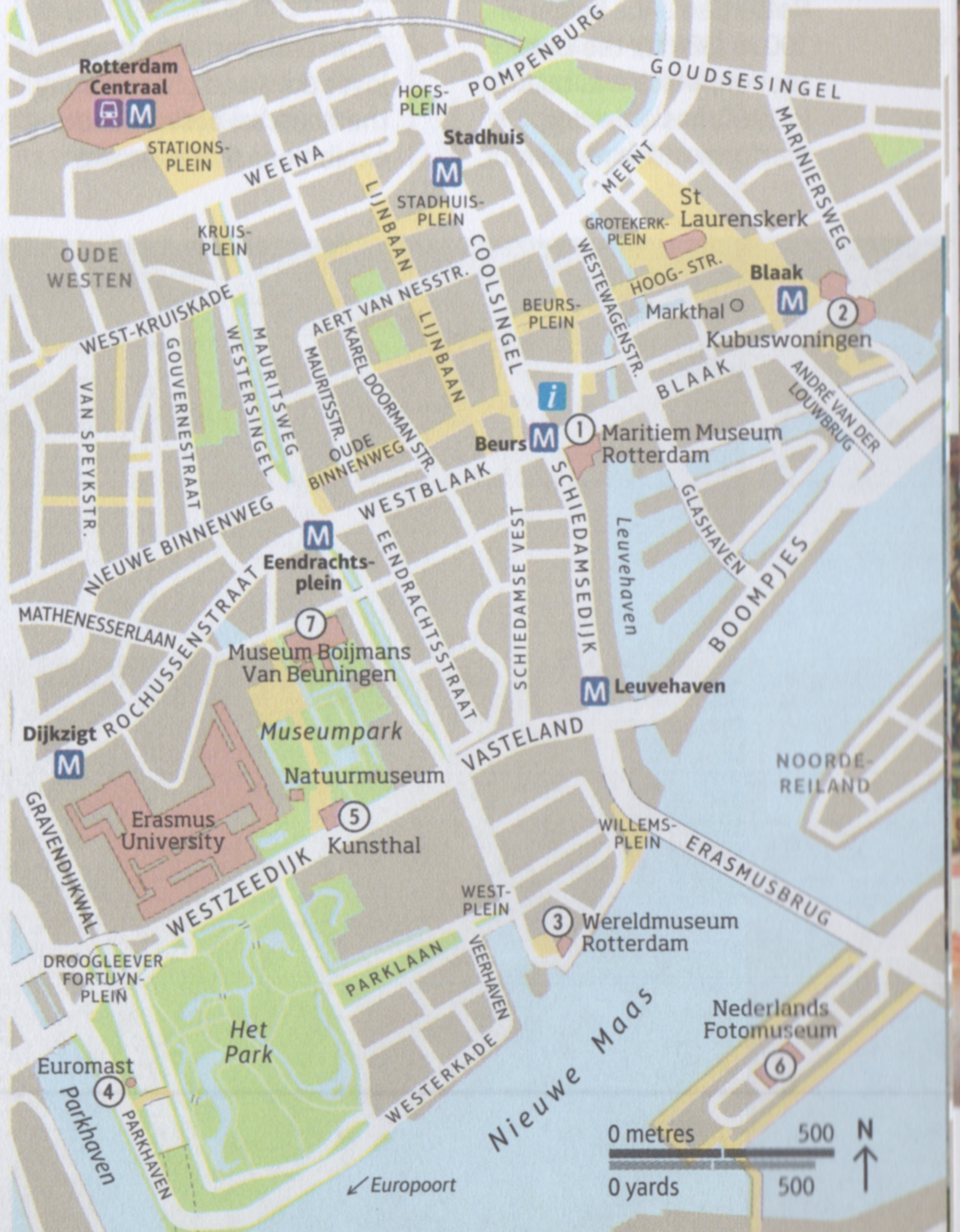

Also in Rotterdam is the Erasmus University Medical Center (Erasmus MC), affiliated with Erasmus University and home to its faculty of medicine, the largest and one of the most authoritative scientific University Medical Centers in Europe (Google) (photo below).

In Ghent there is an Erasmus Hotel northeast of the old town, at the east end of the Patersol neighbourhood, just north off the Leie River (see map top of next page).


First free-standing statue in the Netherlands

The statue of Desiderius Erasmus was made by Hendrick de Keyser and unveiled on 30 April 1622. The bronze statue replaced earlier sculptures of the Rotterdam humanist made of wood and stone. The statue is special because it is the first free-standing statue in the Netherlands and the first statue in Europe that was not erected for a royal or military figure. Over the years the statue has stood at various locations in Rotterdam. Since 1963 it stands in front (west) of the Laurenskerk. There is also a so-called monument to Erasmus across the street to the south of the church (see photos below).


Influenced by:
Martin Luther, Thomas More, MORE

Known for: New Testament translations and exegesis, satire, pacifism, letters, best-selling author and editor, and influencer


Parents:, Roger Gerard and Margaret Rogerius

Awards: Counsellor to Emperor Charles V. (hon.)


Erasmus and Anabaptism

The following is based on my reading ab out Erasmus and the Anabaptists from many sources including Wikipedia, GAMEO, The Canadian and Brittanica Encyclopedias and papers found online on the subject Roma variety of websites, as well as Abraham Friesen’s book, Erasmus, the Anabaptists, and the Great Commission.

Although Erasmus wrote clearly and strongly against the corruption plaguing the established Christian church of his time, the Roman Catholic, he managed to evade persecution and martyrdom. This is not to say that he was not called on the carpet on occasion. Indeed, it seems he moved to Basel to escape the atmosphere of persecution in the Low Countries and elsewhere at the time.

Erasmus was the prominent Christian thinker of his day. He further developed the concept of humanism that was appearing in the Renaissance period and earlier into a Christian form. Besides what was mentioned at the beginning of the last pragraph, he wrote on baptism, seeming to favour the biblical and rational form of adult baptism. However, ultimately, he still bowed to the churches’ - Catholic, Lutheran and Reformed - insistence on infant baptism. The concern of these denominations was what would happen to the population if all European infants were not baptized at birth. 

He also wrote strongly on pacifism, which it was more difficult to disagree with him on in principle and in face of Christ’s words and the apparent beliefs and practice of the Early Church before Constantine. He also had words to say with respect to the swearing of oaths. Perhaps more to the point, he wrote on what is known as Christ’s Great Commission to teach all nations and make disciples of believers. He especially focused on the last, saying that the church was failing badly in this area. People were not being taught how to live as believers, and their leaders, like the Old Testament ‘shepherds’ so roundly criticized by the Hebrew prophets, were far from being models worthy of imitation, unlike the Apostle Paul, who felt confident enough in his actions to call new believers to imitate Christ, but also himself (I Thessalonians 1).  

Erasmus’ writings were widely disseminated and read, thanks to the presence of printing presses. Thus, it is known from their own words and the historical record that he was read by Uldrich Zwingli, the reformer in Zurich, and a number of our Anabaptist forebears. It is not so clear whether he and our Anabaptist forebears in Switzerland were reading him simultaneously or even together in the study sessions some of them were a part of with him before the break in 1525. This break was sealed by the mutual baptisms performed on one another by Felix Manz, Conrad Grebel, George Blaurock and others in Manz’s home in Zurich on January 21 of that year. This date is regarded as the beginning of the Anabaptist movement. We also know from his writings that Menno Simons read him.

The question of what role Erasmus played in the development of Anabaptism that is not entirely answered is whether the ideas he had quite clearly postulated as described above were the background for the beliefs th Anabaptists put forward, or whether they came to the same conclusions through biblical studies of their own. The comments of the previous paragraph would be taken by some to believe the former. Regardless, we know that Erasmus and the Anabaptists agreed in many key areas, even though he seems to have continued to renounce them. 


- Lorne Brandt 2024 5 21


Monday, 16 January 2017

Fire Escape, Sinking Ship and Being Born Again

Fire Escape, Sinking Ship and Being Born Again

Some of you might be reading that and wondering, What in the world do those three things have to do with each other? Others of you will already understand.

Some of you have heard the pitch, you have to be born again to escape the fires of hell. Or, to free yourselves of the clutches of this decadently evil and sinking, decaying ship (society). Nowadays, these phrases are probably mostly heard from television or the radio. You might hear them in your church or some special meetings. More so in the past, they were the stock catchphrases of the evangelistic crusades. 

Now, don't get me wrong. I am not entirely knocking any of the above. I have not only attended but also taken part in and supported crusades in the past by Billy Graham, Barry Moore, the, Ken Campbell and the Sutera twins, not to mention Anabaptism's own Brunk brothers and Myron Augsburger. People have experienced changed lives because of the efforts of these teams.

However, as some of them will also honestly admit, based on their own follow-up surveillance, many who make decisions at or around the time of these events, do not follow through. In medicine, when physicians attend a continuing education conference or learn some new guidelines, but don't really end up putting all of that new knowledge into practice, we call that a knowledge gap or a failure of translation of knowledge from word to deed. The same thing happens with many of these evangelistic efforts, whether it is a crusade or television broadcast.

You see, turning away from your old life to follow The Way, or, if you will, being "born again" or "becoming a Christian," is only a start. Somehow though, over the last two or three centuries out of the nearly 10 centuries that The Church has been in existence, too much attention and effort has been put into a certain way of inviting people into The Kingdom of God. We have had John chapter 3, with Jesus’ reference to being born-again and his apparent final words in Matthew 28 emphasized at the expense of a lot of other important biblical material (I used the word apparent because I think I recall reading somewhere that some believe these words were added later to express a certain point of view and may not have been the original words of our Lord). This emphasis on "winning souls" also causes a lot of guilt on the part of those who are constantly reminded that this is what they’re to be about if they want to earn their "stars" in heaven, but find that they're not very successful in “converting” their families, relatives, neighbors, friends or co-workers. In all of this, we seem to forget that we cannot convert anyone, only the Holy Spirit can, and to do so, it needs to find soil that is ready and prepared for the growth of the CD that is planted with the hearing of The Word. This flask is the test of The Church, but one that often we often fail in. That is in part because new converts are often not successfully linked to the physical expression of The Body of Christ somewhere, or even if they are, the receiving congregation doesn't provide a nurturing atmosphere necessary for growth in The Way to continue.

Christianity has too often been reduced to a program, strategies, aimed at getting people in the door of the church building. To be sure, many churches also do a good job of engaging these individuals, their members, in things like small groups. Sometimes the emphasis here is more on fellowship, helping the newcomers feel more like they belong, then that these are an avenue of serious learning more about it what it means to be a Christian and growing in The Way.

Some of these valiant evangelistic efforts are based on the so-called missionary travels of The Apostle Paul. However, what gets lost in the ‘knowledge translation’ here is that the Acts of the Apostles and Paul's own letters indicate that he often spent months and even years in some of these congregations, trying to make sure they were established in The Way, before moving on to a new destination. Not only that, he often returned to spend time in these congregations or dispatched others to make sure they were doing well. And of course, he wrote letters to them, some of which we still have. He and his helpers worked at the individual relational level. This is often lacking in The Church today.

As for our efforts to try and get people through the church doors, The Church in the New Testament and The Early Church times did not even have church buildings to invite people to. If you read the writings of the Early Church, it does not appear that they were very many come if any, individuals engaged in evangelism in the way we are familiar with it today, as described at the beginning of this writing.

Some of us have come to realize that what we have failed to do is cultivate discipleship in the newcomers. This is what the early church took very seriously and was good at. This was all it took for the church to grow slowly but surely so that by the fourth century AD, the Roman Empire, which had been persecuting them to that point, basically capitulated and became Christian. Unfortunately, that led to a whole new other interpretation of Christianity, which set it on another course that was not that helpful, for the next Thousand use and then some. I am referring to what some called Christendom, with all of its ramifications of the union of church and state, but that would be the subject of another article.

What the early church practiced was the development of spiritual virtues. To be sure, there are recorded instances in the New Testament of individuals being converted and baptized on the spot. In other words, becoming members of The Kingdom. What we forget though is that in many of these instances, the individuals, and sometimes their families, were already following God as they knew him from Judaism, so they new a lot about what it meant to be a follower or live the life of a disciple. However, it did not take long when the church moved into the Gentile world, for it to realize that a lot of time and effort needed to be put into helping reprogram, if you will, the pagans to the Christian way of life. Those who became interested by the witness of the word, and more often the action, of their neighbors, and wanted to become a follower of Christ, were assigned to sponsors who worked diligently and intensively with them for a year or two, while they and the rest of the local congregation observed the catechumenate, as they have been come to be called, to see whether they were really showing signs of having the fruits of the Spirit within them. Here again, we have another example of where a Scriptural concept has been somewhat distorted. “The fruits of the Spirit” has to often been interpreted as the number of souls won, instead of spirit-given virtues cultivated.


Many who have been busy doing what they described in the earlier part of this essay are turning their back on it having rediscovered that what we are called to be is faithful where God has placed us, in our neighbourhood or parish (when I dictated that word with my computer's voice recognition, it came out perish, LOL as they say nowadays, which could be true enough as well). What we need to focus on is cultivating virtue, and making sure the needs of ourselves, our fellow saints and our neighbors are met in ways in which we see God working. I suggest that is where we need to direct our efforts in the future.